
A sixteen-month personal and professional training in somatic work, relational skill, emotional leadership, and group facilitation — built for men who work with men. Born from 50 years of pioneering somatic men's work.
Applications reviewed within 7–10 days · A real conversation about fit, not a sales call
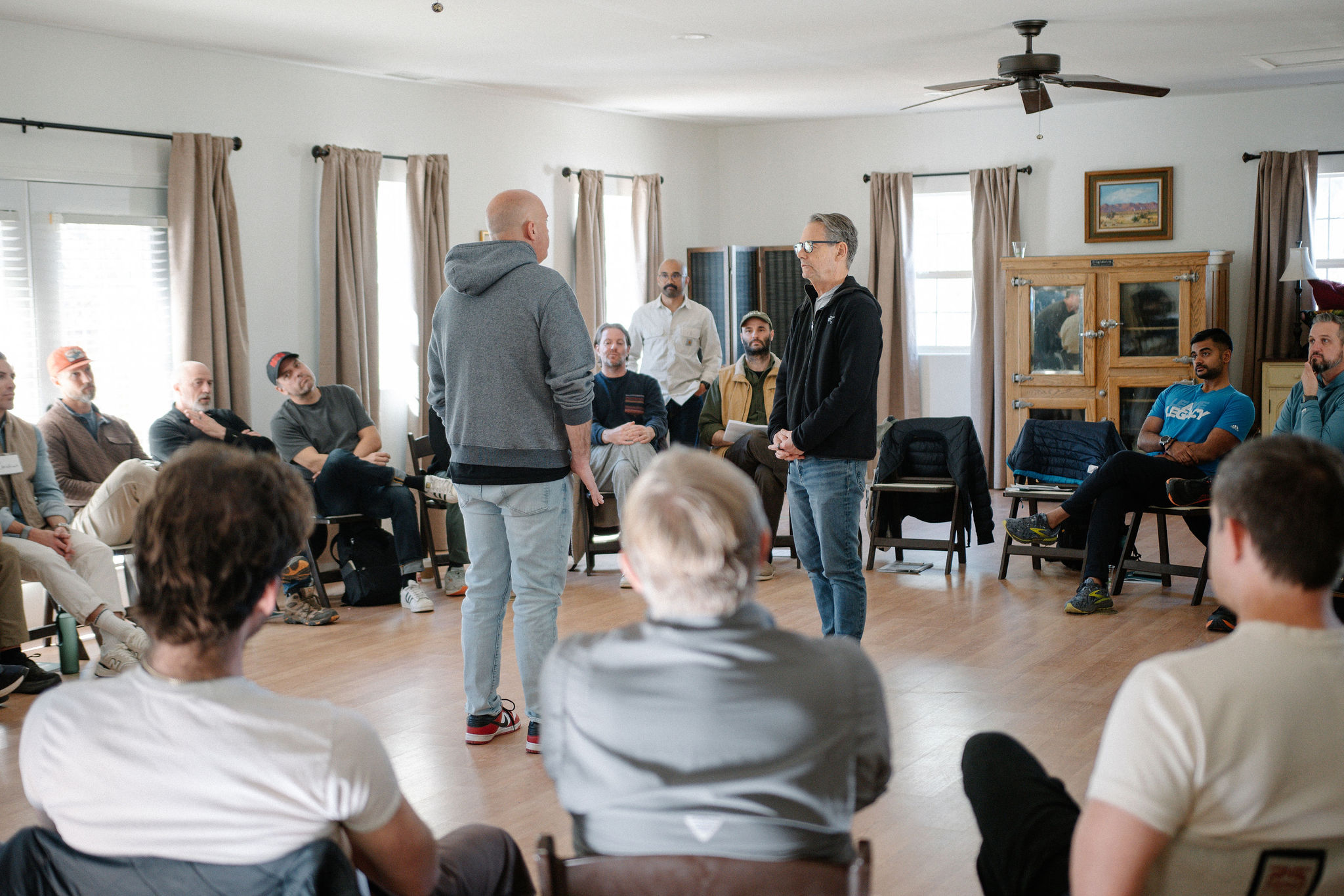
The MELD Integrated Training is a men's work facilitator training built for men who work with men — therapists, coaches, and practitioners adding somatic, one-on-one and group-based skill to what they already do, alongside men stepping into this work for the first time. MELD exists to help men feel better and live more fully, and to train the professionals who guide them. Men come here for their own growth, or to deepen what they already offer, and many find both.
The skills you build will move into your sessions, your clients' marriages, their parenting, their friendships. What shifts in a man tends to change the people around him. MELD has watched that ripple for decades.
There has never been a better time to do this work — and we're honored you're considering joining us.
The serious trainings near this field deserve their reputations. The somatic schools take practitioners through years of careful nervous system work. The attachment-based therapy trainings give clinicians a precise map of connection and repair. The good coaching schools teach contact and inquiry. The established men's organizations create initiation and brotherhood at real scale. Owen trained directly inside several of these lineages, and MELD carries what works in all of them.
Each one also assumes something this work cannot assume. The somatic schools train clinicians for one-on-one private practice. The coaching schools mostly leave out the body — and almost all of them leave out the group. The men's organizations generate powerful experiences but rarely train their leaders in nervous system literacy, attachment, or the actual craft of facilitation.
"A man who feels called to lead men is left to assemble his education from pieces that were never designed to fit together. Many spend a decade and tens of thousands of dollars doing exactly that."
The Integrated Training is the missing program: professional training built specifically for men who want to lead men's work, coach men, and facilitate men's groups — using somatics, relational skill, emotional leadership, and community as the core method.
As far as we know, nothing else like it exists. That is not a boast. It is the reason it took fifty years to build.
The MELD Integrated Training is a sixteen-month formation in working with men — in the body, in relationship, and in groups.
It runs in two parts. For the first four months, you do the deepest personal work MELD offers: 64 lessons, weekly practice with a small cohort, a full monthly teaching day, and a four-day in-person retreat. You learn the method by going through it — in your own nervous system, with the same men, week after week.
Then the training turns professional. Over the following twelve months you learn to facilitate, coach, and lead men with the MELD Method. You practice under supervision, with real clients, until you can demonstrate the skills against a published rubric.
Certification as a MELD Menswork Facilitator (MMF™) is earned, not attended.
Most men who struggle relationally are not emotionally unavailable. They're physiologically inaccessible.
Before a man can feel, name what's happening, or stay present under pressure, his nervous system has to settle enough to let him. When it isn't — when he's bracing, flooding, or already gone — talking at that state doesn't reach him. MELD begins where the shutdown actually begins: in the body.
What looks like avoidance or resistance is often a nervous system in a survival state — before emotion has a chance to surface. Recognizing the cycle changes the intervention.
MELD's clinical sequence moves a man from physiological protection back into relational contact. Three stages, in order. State before technique, always.
Apply ROC as a technique: You help a man slow down enough to feel what's actually happening in his body, name it, and stay in contact while he does. That's the sequence.
In the professional phase, this becomes your clinical lens. You learn to track the male stress cycle as it moves through a man in real time: the laugh that precedes grief, the explanation that replaces fear, the joke at the edge of the thing that matters. You learn to work with each signal — without forcing it, without rushing it, without losing the man in the process.
The personal training. You go through the deepest work MELD offers — anger, fear, sadness, shame, and finally joy. The emotions that run men's lives, one by one, in your body, with your cohort.
Month 3 or 4 · The cohort completes the first arc together. In-person. Required for certification. Full itinerary provided upon acceptance.

The professional training. Attunement, tracking, nervous system work, conflict-to-connection, group facilitation, ethics. Observed against a published rubric. Supervised hours with real clients.
Runs alongside Part 2. Turning your skills into a practice — or strengthening the one you already have.
Skills you will embody.
If you already work with men — in individual sessions, couples work, or group settings — the IT gives that work a body. You know what it looks like when insight stalls. When a client understands his pattern and still can't change it. When he goes blank in session, floods under pressure, or drops out of the room you built together. The MELD Method gives you a somatic and relational entry point that operates at the physiological level, where emotional questions often can't reach.
Many therapists and coaches who train here notice real shifts in their work with male clients within the first few months of Part 1 — before the professional phase has even begun. Some train alongside the men they already serve. Some simply become better at the work they're already doing. All of them develop the skills to lead groups when they're ready.
You're building something. Men's groups, somatic facilitation, a coaching practice organized around work that's already calling you. The IT gives you a method, a certification, and the supervised hours to earn it honestly. You leave qualified to apply the MELD Method with real clients — and with enough practice running groups that you don't have to figure it out alone on the other side.
Most coaching certifications leave out the body entirely. The IT doesn't. You'll learn to read nervous system states, work with activation and shutdown, and build relational depth that most coaching programs never develop. The body becomes the terrain — and groups become a real part of what you can offer.
Not every man who goes through the IT is building a practice. Some come for the capacity itself: to be steadier in their marriage, more present as a father, more useful to the men already around them. What you learn about facilitation carries into every room you walk into. Leading groups becomes an option, not a requirement.

Owen Marcus started in somatic therapies in the mid-1970s, before most of today's trauma language existed. He trained directly with Ron Kurtz, the founder of Hakomi, and Peter Levine, the founder of Somatic Experiencing. He is a Certified Advanced Rolfer. He ran one of the first mindfulness-based stress reduction companies in the country and built an integrated medical clinic where physicians and bodyworkers treated stress at its physiological roots.
He founded the Sandpoint Men's Group — the long-running group that became the subject of a documentary film — and went on to co-found EVRYMAN, where he created and led the programs that trained thousands of men. He has sat in more than ten thousand hours of men's groups. He wrote Grow Up: A Man's Guide to Masculine Emotional Intelligence.
The MELD Method distills all of it. Research on this work was published by the American Psychological Association (Choi and Sabey, Psychology of Men and Masculinities, 2024).


Plus assistants from prior cohorts.
This is not a new program finding its feet. Three full cohorts have completed the Integrated Training, with men joining from across several continents. Some graduates made this work their career; they now run groups and coaching practices of their own. Others folded it into the life they already had — their marriage, their company, their clinical practice, their friendships.
Owen Marcus — Why I built the Integrated Training
"My weekend facilitated by Owen was among the very best, most impactful experiences I have had in a men's group setting. Owen is able to guide men to uncover and discover new parts of themselves and begin to heal in ways that are only rarely possible in this life for most men."
"What I found in the work is the path to pull the veil back from the unconscious mind and consciously choose to integrate and continue forward, unburdened by self-sabotaging mindsets and behaviors. The impact on my family, business, and emotional health is like taking your first breath at birth."
"His weekend workshops have helped me and others break through to new levels of joy, freedom, and self-awareness. If you're ready to profoundly elevate your life, MELD's offerings will create shifts beyond what you can imagine."
Not every man is ready for this training, and not every man who is ready needs it right now. The application and interview exist because the cohort stays together for sixteen months. Choose carefully in both directions.
Four months. 64 lessons. Monthly live teaching days, weekly cohort practice, four-day in-person retreat. Certificate of completion.
Twelve months. Supervised practice, case review, live teaching days. MMF™ certification upon completion.
Concurrent with Part II. Building a practice, positioning, enrollment, ethics. For men starting new and men strengthening existing work.
The application takes about fifteen minutes and asks real questions, because the answers matter. It is the beginning of a real conversation, not a checkout form.
Applications are reviewed within seven to ten days. If it looks like a fit, we schedule a conversation. It runs in both directions — you are deciding about us too.
Accepted men receive the entry assessment, meet their triad, and begin before the first formal session. The cohort stays together for the entire training. That is the design.
The next cohort begins January 2027.
Cohorts are small, launch once a year, and stay together for sixteen months.
If you're asking, you're probably closer than you think. Men don't arrive ready. They arrive willing. The first four months exist precisely to build the capacity the later work requires, and you build it alongside men asking the same question.
No. Some men arrive as therapists or coaches. Others arrive as men whose friends already lean on them. The application and interview sort fit better than any résumé does.
No on both counts — and we're precise about it. MELD facilitators are trained to support regulation, honest expression, repair, and group practice. They're also trained to recognize what needs a clinician and to refer cleanly. That boundary protects your clients and your integrity, and it's part of the certification.
Plan on three to four hours a week, plus one full teaching day a month in Part I and every other month in Part II. The retreats are four days each. It's built for men with full lives, not empty calendars.
Completing Part I earns a certificate of completion. Completing Part II — with supervised hours and observed assessment — certifies you as a MELD Menswork Facilitator (MMF™), qualified to apply and facilitate the MELD Method. [Confirm exact usage rights, listing on the MELD site, and continuing requirements.]
It has been refined across three cohorts and tested for decades before that, in over ten thousand hours of groups. Research on this work has been published by the APA. You won't be asked to take it on faith — you'll feel it working in your own body within the first month, or it's not for you.
Yes. Four or eight months, arranged during enrollment. Limited financial assistance is available for men who need it. Ask during the info call.
Train with the people who helped build this field, in this unique program designed to fill a critical gap.
The next cohort begins January 2027. Cohorts are small, launch once a year, and stay together for sixteen months.
Applications reviewed within 7–10 days · The info call is a real conversation about fit


